What Telegram trading bots actually do
Telegram trading bots are automated programs embedded directly into the Telegram app that execute on-chain trades. Unlike standard exchange bots that rely on API keys and centralized order books, these tools act as intermediaries between your Telegram commands and blockchain RPC nodes. They translate simple text inputs into complex smart contract interactions, allowing you to swap tokens, set limit orders, or snipe new listings without ever leaving the chat interface.
The primary utility of these bots is speed and interface simplification. On decentralized networks like Solana or Ethereum, manual trading through a wallet extension can be slow and prone to user error, especially during high-volatility events. Bots streamline this by pre-loading wallet addresses, handling slippage tolerance, and executing transactions in milliseconds. This automation is critical for strategies like copy trading or front-running, where a delay of even a few seconds can mean the difference between profit and loss.
It is important to understand the infrastructure: these bots do not hold your funds or act as market makers. They simply sign transactions on your behalf using your private key stored locally or in a secure vault. This distinction matters because it places the responsibility for security entirely on you. While the interface is simplified, the underlying risk of interacting with unverified smart contracts remains high.
The 2026 bot landscape and top options
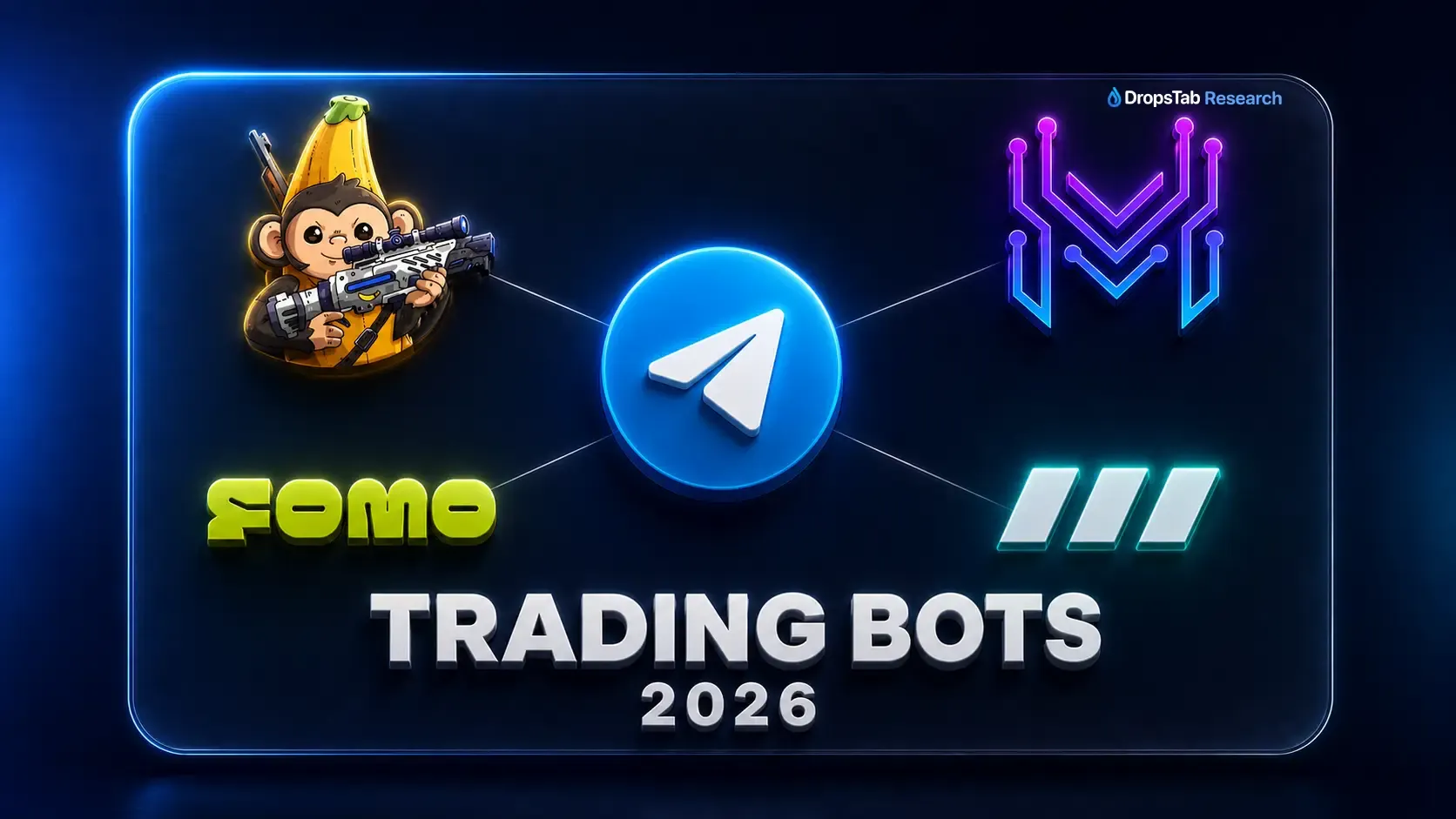
The Telegram trading bot market has consolidated around a few heavyweights that dominate lifetime volume. While dozens of new interfaces appear weekly, the infrastructure relies on a handful of established players like Trojan, BONKbot, and Maestro. These tools handle the high-frequency execution that manual trading cannot match, but they each prioritize different chains and feature sets.
Choosing the right bot depends on whether you need speed on Solana, multi-chain flexibility, or advanced copy-trading capabilities. The comparison below breaks down the primary options by supported networks, fee structures, and core mechanics.
Comparison of Leading Bots
| Bot Name | Primary Chains | Fee Structure | Key Features | Security Model |
|---|---|---|---|---|
| Trojan | Solana, Base | ~1% per trade | Fast execution, anti-rug, copy-trading | Private key encryption, audited smart contracts |
| BONKbot | Solana | ~1% per trade | Low latency, simple UI, limit orders | Non-custodial, user-managed keys |
| Maestro | Multi-chain (ETH, BSC, Sol) | ~1% per trade | Advanced copy-trading, sniper tools | Multi-signature support, role-based access |
| Banana Gun | Ethereum, BSC | ~1% per trade | MEV protection, anti-gas wars | Secure key storage, transaction simulation |
| SolTradingBot | Solana | ~1% per trade | Basic sniping, token analysis | Open-source core components |
Data aggregated from official documentation and independent volume tracking as of early 2026. Fees may vary based on token volume or promotional periods.
Trojan and BONKbot remain the dominant forces on Solana due to their execution speed and community trust. Trojan’s integration with advanced risk management tools, such as anti-rug protection, makes it a preferred choice for high-volume traders. BONKbot, conversely, offers a streamlined interface that appeals to users prioritizing simplicity and speed over complex feature sets.
Maestro stands out for its multi-chain support, allowing traders to manage positions across Ethereum, BSC, and Solana from a single dashboard. This is particularly useful for arbitrage strategies or traders who diversify across ecosystems. Its copy-trading features are among the most sophisticated, enabling users to mirror the moves of successful wallets with customizable slippage and risk parameters.
For Ethereum and BSC traders, Banana Gun provides essential MEV (Maximal Extractable Value) protection, which helps prevent front-running and sandwich attacks. While its interface is less intuitive than Trojan’s, its security features are critical for high-value transactions on congested chains.
Infrastructure and Security Risks
Telegram trading bots operate on a fragile infrastructure that prioritizes speed over security. Unlike a dedicated wallet app, these bots function as intermediaries, requiring you to grant them access to your funds through API keys or direct wallet connections. This architecture creates a single point of failure: if the bot’s backend is compromised, or if the developers behind the service are malicious, your capital is immediately at risk.
The most critical vulnerability lies in private key management. Most Telegram bots do not use secure, multi-signature vaults. Instead, they often store private keys in plain text on their servers or rely on browser extension-like permissions within the Telegram interface. This means you are effectively trusting a third-party server with the keys to your assets. If the bot’s security protocols fail—a common occurrence in the unregulated crypto bot space—your funds can be drained instantly. Never share your seed phrase, and treat any bot asking for full wallet access as a potential honeypot.
Beyond direct theft, you face significant technical risks from RPC (Remote Procedure Call) dependencies and smart contract exploits. Telegram bots rely heavily on public RPC nodes to broadcast transactions. These nodes are often congested, slow, or unreliable, leading to failed transactions or stuck orders. More dangerously, bots execute trades by interacting with smart contracts. If you trade a new token through a bot, you are approving that token’s contract to spend your funds. Malicious tokens can include hidden functions that drain your wallet upon approval, a tactic known as a "rug pull" or "drainer contract."
The risk of API compromise extends beyond just the bot provider. Many users connect their primary exchange accounts (like Binance or Coinbase) to Telegram bots for automated trading. This exposes your exchange API keys to the bot developer. If the bot developer has poor security hygiene, or if their service is hacked, your exchange account becomes vulnerable. Always use API keys with "trade-only" permissions and never enable withdrawal permissions, but even then, the risk remains non-zero.
The technical reality is that Telegram bots are not designed for long-term storage or high-value holdings. They are execution tools for short-term, high-frequency trading. The convenience of executing trades from a chat interface comes at the cost of security audits and regulatory oversight. If you choose to use them, limit the funds you allocate to what you can afford to lose entirely, and regularly revoke API permissions once you are done trading.
Building your own bot infrastructure
If the pre-built bots don't fit your specific strategy, you can build a custom execution layer. This path requires more technical overhead but gives you full control over logic, risk parameters, and execution speed. The primary challenge isn't the Telegram interface—it's connecting that interface to a reliable on-chain execution engine.
1. Select an execution provider
You need a backend that handles wallet management and transaction broadcasting. Two official options dominate the current landscape:
- Coinbase Developer Platform (CDP): Best for multi-chain support. CDP provides infrastructure to manage keys and broadcast transactions across EVM networks. Their template-based approach reduces boilerplate code.
- Privy: Ideal if you prioritize secure key management. Privy focuses heavily on account abstraction and secure signing, which is critical when handling private keys in a bot environment.
2. Set up the Telegram webhook
Telegram bots operate on a webhook model rather than long-polling for production use. You'll need to register your bot with the BotFather, then point your server to a secure endpoint that receives incoming messages. This endpoint parses user commands (like /buy or /sell) and routes them to your execution logic.
3. Implement execution and risk checks
Before broadcasting a transaction, your code must validate the trade. This includes checking slippage tolerance, verifying the contract address against a safety list, and ensuring the wallet has sufficient balance. Never hardcode private keys; use the secret management features provided by your chosen backend (CDP or Privy).
4. Test on a testnet
Never run a new bot on mainnet without rigorous testing. Use Sepolia for Ethereum-based tokens or a Solana devnet for SPL tokens. Verify that your webhook receives messages correctly and that your transactions are signed and broadcasted without errors.
Create your developer account on Coinbase Developer Platform or Privy. Generate your API keys and store them in environment variables, never in your source code.

Use the BotFather to create your bot, then set up a secure HTTPS endpoint to receive updates. Ensure your server can handle incoming JSON payloads from Telegram.
Write the code that parses commands and interacts with the blockchain. Integrate your chosen provider's SDK to handle signing and broadcasting transactions securely.
Deploy your bot to a testnet environment. Simulate various trade scenarios to ensure your risk checks and error handling work as expected before going live.
Market performance and strategy
Bot usage shifts market dynamics by compressing timeframes and amplifying volatility. When multiple automated agents target the same liquidity pool, execution speed becomes the primary differentiator. This environment introduces specific risks like slippage and MEV (Miner Extractable Value), where bots front-run or sandwich trades to extract value from slower human traders.
Timing is critical in these high-stakes environments. A delay of even a few seconds can mean the difference between a profitable entry and a loss. Bots that prioritize low-latency connections to RPC nodes often outperform those relying on standard public endpoints. Understanding this infrastructure advantage helps traders evaluate which tools truly offer an edge versus those that merely promise it.
To visualize this volatility, consider the price action of high-volume meme coins, where bot activity can cause sharp, artificial spikes. These patterns are often short-lived and driven by automated buy walls rather than organic demand. Traders must recognize that these spikes may not reflect true market sentiment but rather the aggressive execution of pre-programmed strategies.
Common questions about bot trading
Telegram trading bots are functional tools that execute orders faster than manual clicking, but they are not magic money printers. Success depends entirely on your strategy, risk management, and the specific infrastructure you choose. Below are direct answers to the most frequent questions from traders navigating this space.
No comments yet. Be the first to share your thoughts!