How Telegram bots connect to markets
Telegram trading bots don’t trade on their own; they rely on infrastructure to reach the market. Understanding how a bot connects determines your security posture, execution speed, and which tokens you can actually trade.
There are two primary models: CEX API connections and on-chain RPC connections. The choice between them defines whether you are trading centralized exchange inventory or interacting directly with the blockchain.
Centralized Exchange (CEX) API
CEX-linked bots use API keys generated inside your exchange settings. You paste these keys into the bot, granting it permission to place orders on your behalf within that exchange’s order book.
This model is straightforward but carries specific risks. The bot interacts with a central server, meaning you must trust the exchange’s security and the bot developer’s handling of your keys. Most bots using this method support stop-loss and take-profit orders, copy trading, and multi-wallet management through the exchange’s existing interface.
On-Chain RPC Connections
On-chain bots connect directly to the blockchain via Remote Procedure Call (RPC) nodes. Instead of API keys, they use private keys or smart contract wallets to sign transactions.
This approach allows trading on decentralized exchanges (DEXs) and access to new token launches that haven’t listed on centralized exchanges. However, it requires a deeper understanding of gas fees, slippage settings, and wallet security. A compromised private key here often means total loss of funds, unlike the account recovery options available on many CEXs.
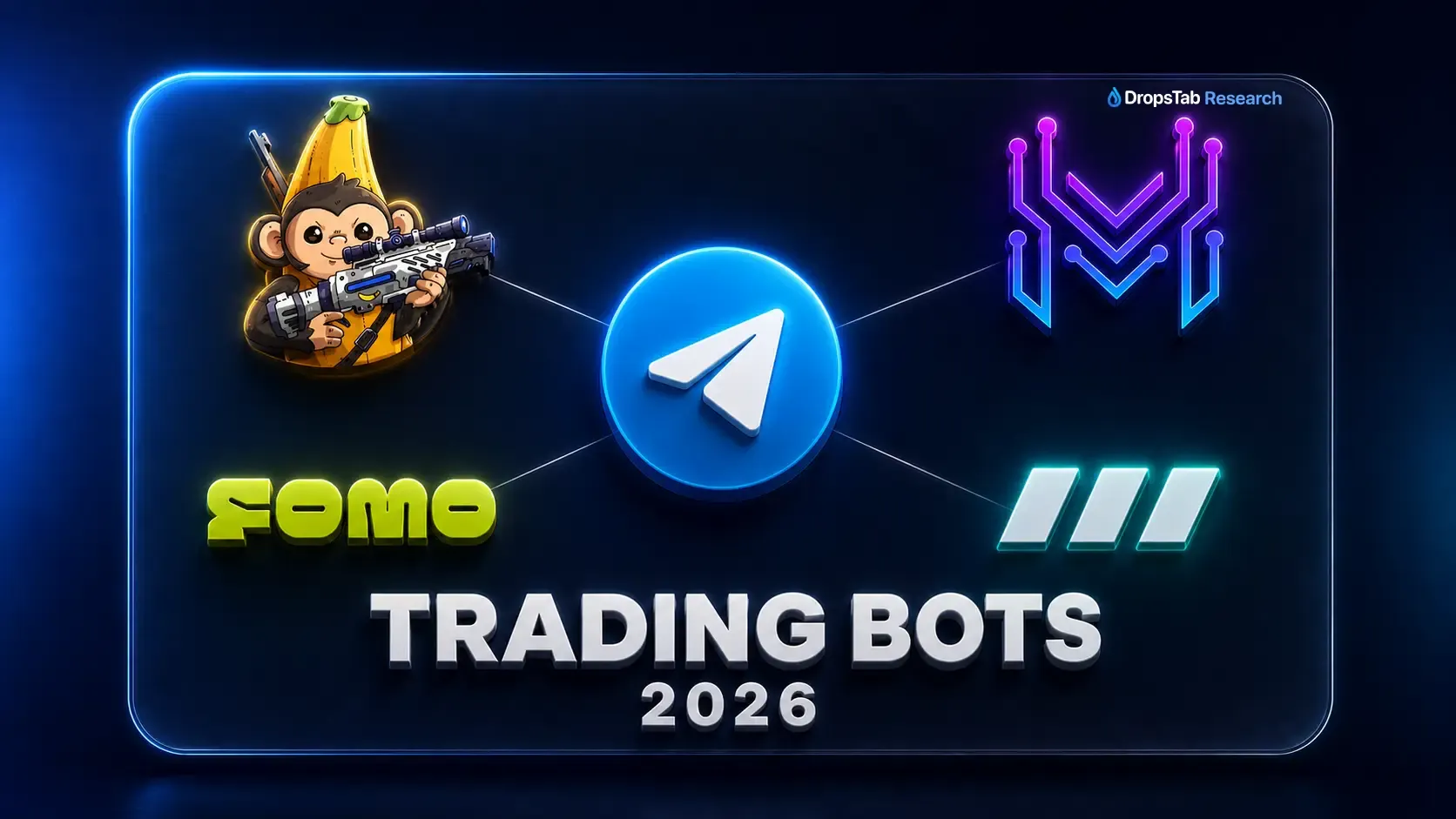
Top Telegram trading bots for 2026
Choosing a Telegram trading bot requires matching the tool to your specific chain and risk tolerance. The market has consolidated around five primary contenders, ranked by lifetime trading volume and community reliability. These bots act as your execution layer, bridging the gap between manual analysis and high-speed on-chain action.

Trojan
Trojan is widely regarded as the most versatile option for Ethereum and Base chains. It excels in high-frequency trading scenarios where speed is critical. The bot offers advanced features like auto-sniping and customizable slippage settings, allowing traders to navigate volatile memecoin launches without manual intervention. Its interface is clean, and it supports multiple wallets for portfolio diversification.
BONKbot
For Solana traders, BONKbot is the default choice due to its lightning-fast execution on the Solana network. It is designed for simplicity, making it accessible to beginners while still offering powerful tools for advanced users. Key features include anti-rug protection and one-click buy/sell commands. The bot integrates seamlessly with popular Solana wallets, ensuring that transactions are processed with minimal latency.
Maestro
Maestro is a multi-chain powerhouse, supporting Ethereum, BSC, Polygon, and Arbitrum. It is known for its robust security features, including private RPC nodes to prevent front-running. The bot offers a comprehensive dashboard for tracking performance and managing settings. Maestro is particularly favored by traders who operate across multiple ecosystems and need a unified interface for all their activities.
Banana Gun
Banana Gun is a veteran in the space, primarily focused on Ethereum. It is renowned for its sniper capabilities, allowing users to buy tokens in the same block they are listed. The bot includes advanced features like limit orders and auto-sell triggers, which are essential for managing risk during high-volatility events. Its long-standing reputation makes it a reliable choice for experienced traders.
SolTradingBot
SolTradingBot is another strong contender for Solana-based trading. It offers a balance of speed and ease of use, with features like auto-buy on liquidity addition and customizable slippage. The bot is lightweight and efficient, making it suitable for traders who want to execute trades quickly without navigating a complex interface. It is particularly effective for trading new Solana tokens and NFTs.
| Bot | Chains | Best For |
|---|---|---|
| Trojan | ETH, Base | Speed & Versatility |
| BONKbot | Solana | Execution Speed |
| Maestro | Multi-chain | Security & Dashboard |
| Banana Gun | Ethereum | Sniping & Limits |
| SolTradingBot | Solana | Ease of Use |
Securing your bot infrastructure
Running a trading bot is less about coding skill and more about operational security. If your infrastructure is compromised, the losses are immediate and irreversible. You need to treat your bot’s access credentials like physical vault keys: never leave them unattended, and never let them touch the main vault.
Key Management and Wallet Hygiene
The most common failure point is poor key management. Never use a hot wallet with significant funds for bot trading. Instead, use dedicated burner wallets with strict allowance limits. If you are using a CEX-linked bot, generate specific API keys with "trade-only" permissions and disable withdrawals entirely. For on-chain bots, consider using Privy’s infrastructure to isolate wallet interactions. Privy allows you to build bots that manage user wallets without exposing private keys to your server, significantly reducing the attack surface [[src-serp-1]].
Contract Auditing and MEV Protection
Even with perfect security, smart contract risk remains. Always audit the token contracts your bot interacts with. Look for red flags like mint functions or pausable transfers. Additionally, consider MEV (Maximal Extractable Value) protection. Standard bots are vulnerable to front-running; using MEV-protected execution paths, such as those available on BASE [[src-serp-6]], can prevent your trades from being sandwiched by bots.



As an Amazon Associate, we may earn from qualifying purchases.
Execution Strategy and Slippage Control
Configuring your Telegram trading bot is less about picking a signal and more about setting the rules of engagement. Once the bot connects to your exchange via API keys, you define the parameters that determine whether a trade succeeds, fails, or gets front-run. The goal is to balance speed with cost, ensuring you get filled without paying unnecessary premiums.
Gas Fees and Transaction Priority
In high-volatility markets, standard transaction fees often result in delayed execution. You need to configure your bot to adjust gas prices dynamically based on network congestion. For Ethereum-based tokens, this means setting a base fee that prioritizes inclusion in the next block. On Solana, it involves setting a priority fee to ensure your transaction processes quickly during peak usage. Ignoring this is like sending a letter via standard post when you need a courier; the message arrives, but too late to matter.
Slippage Tolerance
Slippage is the difference between the expected price of a trade and the price at which the trade is executed. For meme coins with low liquidity, a tight slippage tolerance (e.g., 1-2%) might cause your order to fail entirely. Conversely, a loose tolerance (e.g., 10-20%) protects the fill but risks buying at a significantly worse price. A common strategy is to set a baseline slippage (e.g., 5%) and allow the bot to adjust it slightly for large market moves, but never leave it open-ended. Always cap your maximum slippage to prevent catastrophic losses from sudden price gaps.
Anti-MEV Protections
Maximal Extractable Value (MEV) bots scan the mempool for profitable trades and can front-run or sandwich your transactions. To protect yourself, use bots that support private transaction relays or flashbots. These methods send your transaction directly to validators, bypassing the public mempool where MEV bots lurk. If your bot doesn’t support this natively, consider routing trades through privacy-focused services or using encrypted transaction bundles. This isn’t just a technical feature; it’s a shield against predatory algorithms.
Build your own Telegram trading bot with CDP
If you want full control over execution logic and data flow, building a custom bot using the Coinbase Developer Platform (CDP) is the most reliable path. Instead of relying on opaque third-party tools, you write the code that handles market data, risk checks, and order placement. This approach requires more engineering effort, but it eliminates the counterparty risk of trusting a black-box service with your API keys.
The foundation is the CDP SDK, which provides the necessary interfaces to interact with Coinbase's trading infrastructure. You will need to set up a developer account, generate specific API keys with limited permissions, and configure your Telegram bot to act as the command interface. The official documentation from Coinbase provides the exact endpoints and authentication flows required to get started.
Step 1: Set up your CDP environment
Start by creating a Coinbase Developer Platform account and enabling the Trading API. Generate API keys with the minimum necessary permissions—typically trade and view—to limit exposure if your bot is compromised. Store these keys in environment variables, never in your codebase. You will use the CDP SDK to initialize the client with these credentials.
Step 2: Configure the Telegram webhook
Register your bot with BotFather on Telegram to get your bot token. Set up a webhook that points to your server, so Telegram can send real-time updates (like user commands or trade signals) to your backend. This ensures low-latency communication between the chat interface and your trading logic.
Step 3: Implement core trading logic
Use the CDP SDK to fetch market data and execute trades. Define your strategy parameters, such as entry/exit thresholds and position sizing, directly in your code. This is where you add safety checks, like maximum drawdown limits or circuit breakers, to prevent runaway losses.
Step 4: Test on testnet before going live
Before risking real capital, run your bot on the Coinbase testnet. The testnet mirrors mainnet behavior with fake money, allowing you to validate your logic, webhook integration, and error handling without financial risk. Only move to mainnet after rigorous backtesting and live simulation.
Register on the Coinbase Developer Platform and generate API keys with restricted permissions. Store credentials securely in environment variables to prevent leaks.

Create a bot via BotFather and set up a webhook to route user commands to your server. This establishes the real-time communication channel between Telegram and your trading engine.
Use the CDP SDK to fetch market data and execute orders. Define your strategy parameters and safety checks, such as max drawdown limits, directly in your code.
Run your bot on the Coinbase testnet to validate logic and integration with fake money. Only go live after rigorous backtesting and simulation to ensure stability.
This infrastructure gives you transparency and control, but it also means you are responsible for security, uptime, and bug fixes. For most developers, the trade-off is worth it to avoid the hidden risks of third-party bots.
Common questions about Telegram bots
Telegram trading bots connect to markets through two distinct routes, depending on the infrastructure. CEX-linked bots use API keys generated from your exchange settings, granting the bot permission to place orders on your behalf. On-chain bots, by contrast, connect directly to the blockchain, often requiring wallet signatures rather than exchange credentials.
Most bots share common features including stop-loss and take-profit orders, copy trading, and multi-wallet support. These tools automate execution, but they do not replace market analysis. You must still monitor positions and understand the risks of automated trading.
No comments yet. Be the first to share your thoughts!